
INTRODUCTION
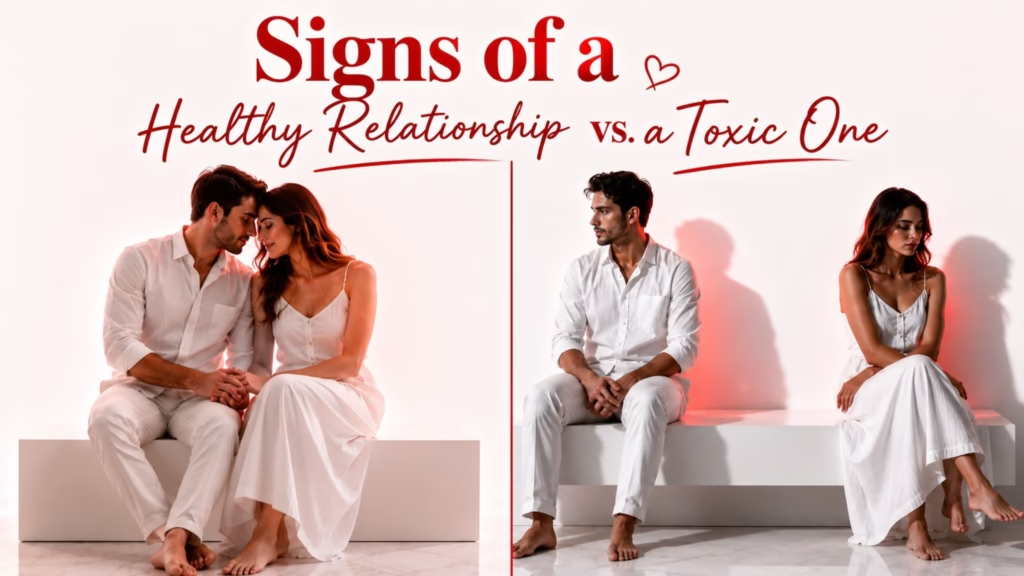
Signs of a healthy relationship are usually quieter than people expect. No grand gestures, no constant reassurance needed — just a steady sense of being safe with someone. And honestly, that’s exactly why toxic patterns are so easy to miss for so long. They don’t always show up as something dramatic either. Sometimes it’s just a slow discomfort you’ve gotten used to explaining away.
I put this together as an actual checklist, not just a vague list of feelings, because I think it’s easier to be honest with yourself when you can actually tick things off one by one instead of just going with a gut feeling that’s easy to talk yourself out of.
Quick Summary: Healthy vs. Toxic Relationships at a Glance
| Topic | Details |
|---|---|
| Core Difference | A healthy relationship makes you feel more like yourself. A toxic one slowly asks you to become someone smaller. |
| Healthy Sign | Disagreements happen and actually resolve, instead of repeating the same fight on a loop. |
| Toxic Sign | You find yourself apologizing just to keep the peace, even when you didn’t do anything wrong. |
| Why It’s Hard to Notice | Toxic patterns usually build slowly, so your baseline for “normal” shifts along with them. |
| What Actually Helps | Checking your relationship against a real list, not just a feeling, since feelings adjust to whatever you’re used to. |
| When to Take It Seriously | If you recognize more toxic signs than healthy ones, or feel smaller after time with them, not bigger. |
Table of Contents
- What Actually Makes a Relationship Healthy or Toxic
- 10 Signs of a Healthy Relationship
- 10 Signs of a Toxic Relationship
- Quick Side-by-Side Checklist
- Practical Takeaways
- Frequently Asked Questions
What Actually Makes a Relationship Healthy or Toxic
It’s not about how much you fight, how often you say “I love you,” or how exciting things feel. Plenty of healthy relationships have disagreements, and plenty of toxic ones feel intensely passionate. The real difference is simpler than that: a healthy relationship makes room for both people to stay fully themselves. A toxic one, over time, asks one person to keep shrinking so the other can stay comfortable.
That’s really the lens to use for everything below — not “does this feel intense,” but “do I feel more like myself, or less, after time with this person.”
10 Signs of a Healthy Relationship
1. Disagreements actually end. You fight, you talk it through, and it’s genuinely over — not brought back up three weeks later as ammunition.
2. You can say “I don’t like that” without bracing for the reaction. Honesty doesn’t feel like a risk.
3. Your friends and family are still around. A healthy partner doesn’t quietly become your whole social world.
4. Apologies go both ways. Neither person is always the one who has to say sorry first.
5. You feel calmer after tough conversations, not more anxious. Even hard talks leave things clearer, not heavier.
6. Your successes get genuine excitement, not quiet competition. They’re happy for you, not threatened by you.
7. Trust doesn’t need constant proof. You’re not checking their phone, and they’re not checking yours.
8. You can have a bad day without it becoming a bigger issue. Off moods are allowed, not treated as a personal attack.
9. Compromise feels mutual, not one-sided. Some days you bend, some days they do — it roughly balances out over time.
10. You genuinely miss them, not just the good version of the relationship. There’s a difference, and in a healthy one, you don’t have to separate the two.
10 Signs of a Toxic Relationship
1. You’re always the one adjusting. Your plans, opinions, and preferences quietly bend more than theirs ever do.
2. Apologizing has become a reflex. You say sorry even when you’re not actually sure what you did wrong.
3. Your circle has gotten smaller since you got together. Friendships have faded, and it wasn’t entirely your choice.
4. Old arguments get replayed as evidence. Nothing ever really gets resolved — it just gets stored for the next fight.
5. You feel like you’re managing their moods. Walking on eggshells has become a normal part of your day.
6. Affection feels conditional. Warmth shows up when you’re “good,” and coldness shows up when you’re not.
7. You second-guess your own memory of events. Things you clearly remember get reframed until you’re not sure anymore.
8. Jealousy gets dressed up as love. Control gets explained as care, and it’s taken you a while to see the difference.
9. You feel smaller after time together, not bigger. Confidence you had before the relationship has quietly eroded.
10. Deep down, you already know. Most people in a toxic relationship can sense it if they’re honest — the hesitation is usually about what comes next, not confusion about what’s happening now.
Quick Side-by-Side Checklist
| Healthy Relationship | Toxic Relationship |
|---|---|
| Disagreements resolve | Old fights get replayed |
| Honesty feels safe | Honesty feels risky |
| Friends stay part of your life | Your circle has shrunk |
| Apologies go both ways | You’re always apologizing |
| Trust without checking | Constant need to verify |
| Bad days are allowed | Bad days become bigger issues |
| Compromise feels mutual | You’re always the one bending |
| You feel more like yourself | You feel smaller over time |
| Affection feels steady | Affection feels conditional |
| You trust your own memory | You second-guess your own memory |
Practical Takeaways
1. Feelings alone aren’t a reliable measuring stick. Toxic relationships can still feel intense and even loving in moments — that’s exactly why a checklist works better than a gut check alone.
2. Notice the “who you’re becoming” question more than the “how it feels” one. A relationship that makes you smaller over time is telling you something, even if it still feels good some days.
3. One or two toxic signs isn’t automatically a crisis. No relationship is perfect. What matters is the overall pattern, not a single item on this list.
4. If you recognize yourself in most of the toxic list, that’s information, not overreaction. It’s worth taking seriously rather than explaining away.
5. Healthy relationships aren’t the absence of problems — they’re the presence of repair. The real marker isn’t “we never fight.” It’s “we know how to come back from it.”
Frequently Asked Questions
Can a relationship have some toxic traits and still be worth saving? Yes, especially if both people are willing to acknowledge the pattern and actually change it. The concern is less about a single trait and more about whether it’s acknowledged and addressed, or repeated and denied.
Is jealousy always a toxic sign? Occasional jealousy is human. It becomes toxic when it turns into control, accusations, or monitoring — that’s when it stops being a feeling and starts being a behavior aimed at you.
How do I bring up toxic patterns without starting a fight? Focus on a specific pattern and how it affects you, rather than a list of complaints — something like, “I’ve noticed I apologize a lot even when I’m not sure why, and I want to understand that better together.”
Can you be the toxic one without realizing it? Yes, and it’s worth genuinely reflecting on this checklist for yourself too, not just your partner. Most people who show toxic patterns aren’t doing it deliberately — it’s usually learned behavior that needs to be unlearned.
What’s the very first step if I recognize a toxic relationship in myself? Start by naming the specific pattern honestly, ideally with a therapist or a trusted person outside the relationship, since it’s genuinely hard to see clearly from inside it.
If this checklist felt familiar, you might also relate to Signs You’re Not a Priority in Their Life and Signs You’re in a Situationship — both dig deeper into specific patterns that often show up in the “toxic” column above.
Suggested Tags: healthy relationship signs, toxic relationship signs, relationship checklist, relationship advice 2026, dating red flags, healthy vs toxic relationship, relationship psychology